
Purpose
In pool applications, backwashing is not only about keeping the membranes clean. It is a central part of maintaining stable operation and controlling how solids are handled in the system over time.
In this type of system, TMP is closely linked to the level of fouling on the membranes. As the load on the pool increases, more solids are introduced into the system, and TMP will increase accordingly. Variations in bather load and general water quality conditions will therefore directly influence how quickly fouling builds up.
A well-balanced backwash strategy ensures that this fouling is managed continuously, avoids unnecessary stress on the system, and delays the need for chemical cleaning (CIP).
How backwash works in this system
A backwash cycle consists of two distinct steps with different roles.
First, an air scour (blower) is applied. This step loosens particles and fouling from the membrane surface and is the primary cleaning mechanism.
This is followed by a short water backwash, typically only a few seconds, which flushes the loosened material out of the membrane channels and to drain.
This distinction is important: the effectiveness of the backwash is governed by the air step and how frequently cleaning is performed — not by simply extending the duration of the water backwash.
Understanding baseline – the key to stable operation
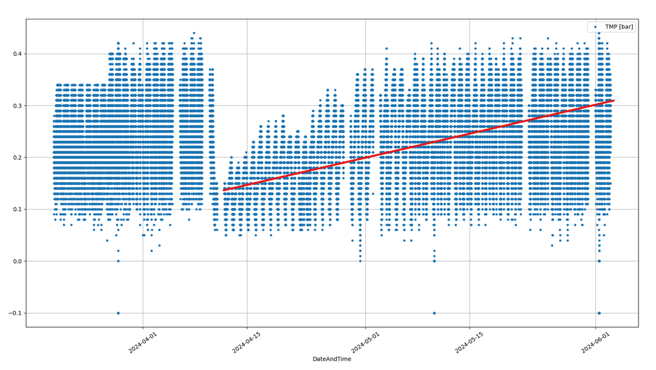
To operate the system correctly, TMP behaviour must be followed over time, with particular focus on the baseline after each backwash.
After a backwash, TMP should drop back to a relatively stable level. This level is referred to as the baseline and represents the current fouling state of the membranes.
In stable operation, TMP will increase during filtration and then return to approximately the same baseline after each backwash. This indicates that fouling is being effectively controlled.
If the baseline starts to move upward over time, it is a sign that fouling is accumulating and that the current backwash strategy is no longer sufficient.
How to adjust backwash in practice
When TMP increases between backwashes, this is expected and reflects that the system is capturing solids.
If TMP begins to increase faster than before, this typically indicates higher loading conditions, for example due to increased pool usage. In this situation, the correct response is to reduce the time between backwashes by increasing their frequency.
As long as the system consistently returns to the same baseline after backwash, the current strategy is adequate.
If the baseline begins to increase slowly, it indicates that the system is no longer fully restored by backwash. Increasing backwash frequency can help stabilize operation temporarily, but this should be seen as a sign that fouling is building up.
When backwash is no longer sufficient
Backwash is a maintenance step and is not intended to restore heavily fouled membranes.
A clear indication that a CIP is required is when the system no longer returns to its previous baseline after backwash.
Another important indicator is when TMP-triggered backwashes begin to occur very frequently. If the system repeatedly initiates backwash based on TMP with only limited or short-lived effect, it indicates that fouling has reached a level where backwash alone cannot maintain stable operation.
In practice
The following are strong indicators that a CIP should be considered:
- Increasing backwash frequency no longer stabilizes TMP
- The baseline continues to rise
- Backwash is triggered repeatedly within short intervals
- TMP quickly returns to elevated levels after backwash
These are clear signs that a CIP should be performed rather than continuing to rely on increasingly aggressive or frequent backwashing.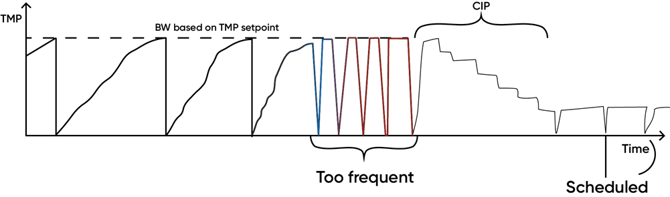
Backwash as part of water management
Backwash should also be considered as a controlled way of removing water from the system.
If dissolved solids (e.g. TDS) become an issue, simply discharging water directly to drain does not provide any benefit to the filtration system. In contrast, increasing the frequency of backwash allows the system to:
- Remove accumulated solids from the membranes
- Maintain a lower and more stable TMP
- Simultaneously contribute to the required water exchange
In this way, backwash serves a dual purpose: maintaining membrane performance while supporting water quality control.
Temporary adjustment after contamination or water quality events
In certain situations, such as:
- vomit or fecal incidents
- chemical imbalance
- sudden turbidity or poor water clarity
it can be beneficial to temporarily adjust the backwash strategy.
This can include:
- increasing backwash frequency
- temporarily extending the flush duration
- using backwash more actively as part of controlled water replacement
This may help:
- remove suspended contamination faster
- increase water exchange in a controlled way
- support recovery of water quality together with the site’s normal pool water treatment response
Such adjustments should normally be considered temporary and should be returned to normal once the situation has stabilized.
Practical setup of backwash
In daily operation, backwash should be configured as a combination of scheduled cleaning and TMP-based control.
Scheduled backwashes
Scheduled backwashes are used to limit how long solids remain on the membranes and should typically be placed:
- Before opening
- After closing
- And, if required, during operation
This creates a more proactive and stable cleaning pattern rather than relying solely on system response after fouling has already built up.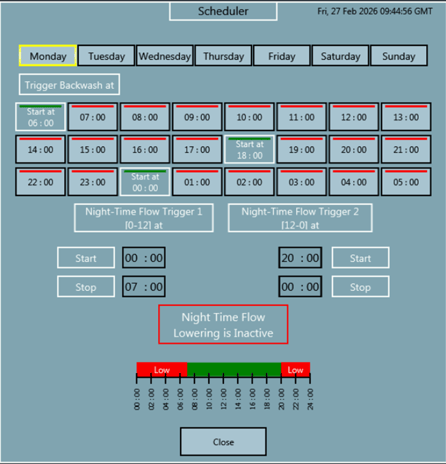
TMP-triggered backwash
TMP-triggered backwash acts as a safeguard and ensures that the system responds automatically to increasing membrane load.
This is especially useful during:
- high bather load
- events or peak hours
- changing water quality conditions
- situations where fouling builds faster than normal
The two approaches serve different purposes and should be used together:
- Scheduled backwash provides stability
- TMP-triggered backwash provides protection
A robust strategy typically includes both.
Summary
A good backwash strategy is defined by stable operation over time, not aggressive cleaning.
TMP serves as a direct indicator of fouling, and the baseline after backwash is the most important parameter to follow. As long as the baseline remains stable, the system is operating as intended.
When the baseline begins to rise, or when backwash is triggered repeatedly without restoring performance, it is a clear indication that the system is approaching the need for CIP.
Backwash should also be used actively as part of water management, where increased frequency can both improve membrane performance and contribute to controlled water exchange.
Related article
For a more technical explanation of TMP and how a backwash sequence works physically in the system, see:
Understanding TMP and backwash sequence in pool systems